
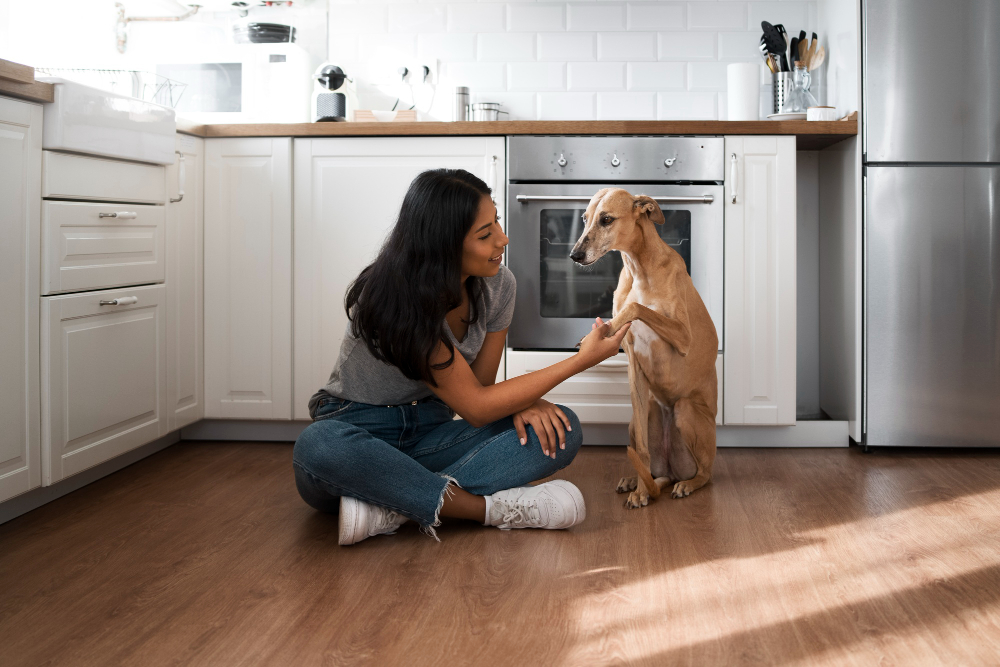
Dog nails, muddy paws, spilled juice, dropped toys, potty training accidents, and the occasional unfortunate hairball. A floor in a home with pets and kids doesn’t just get used — it gets tested, daily, in ways the showroom sample never anticipated.
The good news is that flooring technology has improved dramatically in exactly the areas that matter for family homes. There are genuinely excellent options that look beautiful and shrug off real life. The trick is knowing which specifications actually predict durability and which are marketing language.
The Three Things That Actually Matter
Before comparing materials, it helps to know what you’re evaluating. For pets and kids, three properties determine whether a floor thrives or fails:
- Scratch resistance. Dog nails are the primary threat to hard surface flooring. A large dog running across a room concentrates significant force through four small points. Softer materials record every one of those points permanently.
- Moisture resistance. Accidents, spills, wet paws, and dropped cups are constant in family homes. What matters is not just whether the surface repels water, but what happens when liquid reaches the seams and sits there.
- Cleanability and stain release. A floor you can actually get clean — quickly, without special products — is a floor you’ll stay happy with. Anything that requires careful blotting technique and a specialty cleaner is going to lose.
Comfort and slip resistance matter too, particularly for older dogs and crawling toddlers. We’ll cover those where relevant.
Best Overall: Rigid Core Luxury Vinyl Plank
If we could recommend one flooring type for the average family home with pets and kids, this would be it — and it isn’t close.
Rigid core LVP with a 20-mil wear layer is fully waterproof, highly scratch resistant, comfortable underfoot, quiet, warm, and cleans with a damp mop. It handles a potty-training accident that sits unnoticed for hours. It handles a large dog sprinting to the door. It handles a dropped bowl of cereal. And when the worst does happen and a plank is damaged beyond repair, a single plank can often be replaced without redoing the room.
Specification guidance for pet and kid households:
- Wear layer: 20 mil minimum. The 6-mil and 12-mil products are fine for adult households; they are not what you want with a golden retriever.
- Core: SPC for maximum dent resistance and dimensional stability, WPC if underfoot comfort is a higher priority than dent resistance.
- Finish: matte or low-sheen. Glossy finishes make every scratch and paw print visible; matte finishes hide both remarkably well.
- Pattern: multi-tone wood looks with visible graining conceal minor wear far better than uniform single-tone colors.
- Texture: embossed-in-register texture adds realism and provides better traction for dogs than a smooth surface.
Best for Extreme Durability: Porcelain Tile
Nothing beats porcelain tile for pure resistance. It is essentially immune to scratching from pet nails, completely waterproof, and unaffected by any spill a household is likely to produce. In entryways, mudrooms, and laundry rooms — the zones where wet dogs and muddy boots enter — porcelain is the correct answer.
The trade-offs are real, though. Tile is hard, cold, and unforgiving. A toddler learning to walk will fall on it. A dropped glass will shatter rather than bounce. Older dogs with joint issues can struggle on smooth tile, and polished finishes are genuinely slippery for animals. Grout lines also collect dirt and can stain if not sealed or if a cement grout is used in a high-accident area.
If you go this direction, specify a textured or matte finish rather than polished, and consider epoxy or urethane grout for stain resistance. Area rugs and runners solve most of the comfort and traction concerns in the spaces where they matter.
Best Real Wood Option: Engineered Hardwood in a Hard Species
Many families want real wood and shouldn’t be talked out of it — but the species and finish choices matter enormously.
If hardwood is what you want, specify a hard species with a high Janka rating. Hickory (1,820) and white oak (1,360) hold up considerably better than walnut (1,010) or American cherry (950). A wire-brushed or hand-scraped surface texture is your best friend here: it disguises new scratches within an existing pattern of intentional texture, which is why these finishes have become so popular in family homes. Matte and satin sheens outperform semi-gloss and gloss dramatically in hiding wear.
Set expectations honestly, though. Any real wood floor in a home with a large dog will develop character marks. Some families genuinely love the patina that results; others are frustrated by the first scratch. If you’re in the second group, LVP will make you happier.
Engineered construction is preferable to solid in family homes because it tolerates humidity swings and spills better, and it can go over a wider range of subfloors.
Best for Bedrooms and Play Areas: Solution-Dyed Carpet
Carpet has a bad reputation in pet households that modern products have largely earned their way out of. In bedrooms, playrooms, and finished basements, the softness and safety carpet provides is genuinely valuable — falls on carpet don’t end in a trip to urgent care.
The key specification is solution-dyed fiber. In solution-dyed carpet, color is added to the fiber during manufacturing rather than applied afterward, which means the color goes all the way through and the fiber has no open dye sites for stains to bond to. This makes solution-dyed nylon and triexta dramatically more stain resistant than conventionally dyed carpet — and in many cases they can tolerate diluted bleach cleaning without color loss.
Additional carpet guidance for pet households:
- Choose cut pile or tight-twist frieze over loop pile. Berber and other looped constructions can snag on pet claws and pull.
- Add a moisture-barrier pad. This is the most underrated upgrade in a pet home — it prevents accidents from reaching the subfloor, which is where lingering odor problems actually originate.
- Favor medium-tone, multi-color patterns. They conceal everyday soil far better than solid light or dark colors.
- Consider carpet tiles in playrooms. A single damaged tile can be swapped out rather than replacing the room.
What to Avoid
Some products simply don’t belong in a home with pets and young children, regardless of how good they look on the showroom floor:
- Laminate flooring. Despite the hard, scratch-resistant surface, the fiberboard core swells irreversibly when water reaches the seams — and that swelling can’t be repaired. Modern rigid core LVP outperforms laminate on essentially every metric that matters here.
- Softwood species. Pine, fir, and similar softwoods dent under dog nails and dropped toys almost immediately.
- Polished marble and other soft natural stone. Marble etches from acidic spills, scratches easily, and is slippery when wet.
- High-gloss finishes of any material. Gloss maximizes the visibility of every scratch and paw print, and it’s slippery for dogs.
- Uniform light or dark solid colors. Solid dark floors show every speck of dust, dander, and pet hair. Solid light floors show every bit of dirt. Mid-tones with visual variation are far more forgiving.
- Loop-pile carpet in cat households. Cats will find the loops, and the loops will lose.
A Room-by-Room Strategy for Family Homes
Most families are best served by mixing materials rather than running one product everywhere:
- Entry, mudroom, and laundry: porcelain tile. This is where mud, water, and grit enter the house — stop them here.
- Kitchen, living, and dining: 20-mil rigid core LVP, or hickory/white oak engineered hardwood if real wood is a priority.
- Bedrooms: solution-dyed nylon or triexta carpet with a moisture-barrier pad.
- Playroom or finished basement: carpet tiles or 20-mil SPC LVP, both of which allow spot replacement.
- Bathrooms: porcelain tile with a textured finish and a slip-resistant COF rating.
Simple Habits That Extend Any Floor’s Life
- Keep pet nails trimmed. This is the single highest-impact thing you can do for hard surface flooring.
- Place absorbent mats at every exterior door and under water bowls.
- Use felt pads under all furniture legs, and re-check them annually — they wear out and fall off.
- Clean accidents immediately. The damage from urine is largely a function of how long it sits, not the fact that it happened.
- Vacuum regularly. Grit tracked in from outside acts like sandpaper underfoot and causes more cumulative wear than any single incident.
- Skip steam mops on LVP and hardwood. Heat degrades wear layers and adhesives over time.
Common Questions
Will a large dog scratch luxury vinyl plank?
A 20-mil wear layer resists nail scratching very well under normal conditions. It’s not indestructible — dragging something sharp across it will leave a mark — but everyday running, jumping, and pacing will not visibly damage it. This is precisely where LVP outperforms hardwood most clearly.
Can pet urine permanently damage flooring?
On waterproof surfaces cleaned promptly, no. The lasting problems occur when urine penetrates to the subfloor and isn’t addressed — which is why a moisture-barrier pad under carpet and properly sealed seams on hard surface matter so much. On unfinished or oil-finished hardwood, urine can cause permanent dark staining that requires sanding to correct.
Is carpet a bad idea if someone in the house has allergies?
It’s more nuanced than the common advice suggests. Carpet traps allergens in the fiber, which keeps them out of the air but requires consistent vacuuming with a HEPA filter to remove. Hard surfaces let allergens circulate more freely but are easier to fully clean. For significant allergy concerns, hard surface with washable area rugs is generally the better approach.
What’s the most slip-resistant option for an older dog?
Textured LVP with embossed graining, or carpet. Both give nails something to grip. Polished tile and high-gloss hardwood are the worst choices for dogs with mobility issues — if you already have them, runners along the routes your dog travels most make a meaningful difference.
Find the Right Fit at Trinity Flooring
Every household is different — a single cat and a house full of large dogs and toddlers are not the same specification problem. Our team can walk you through wear layers, fiber types, and finishes side by side in the showroom, and help you build a room-by-room plan that fits how your family actually lives.
Stop by to compare samples in person, or contact us to schedule a free in-home measurement and estimate anywhere in the Portland metro area.