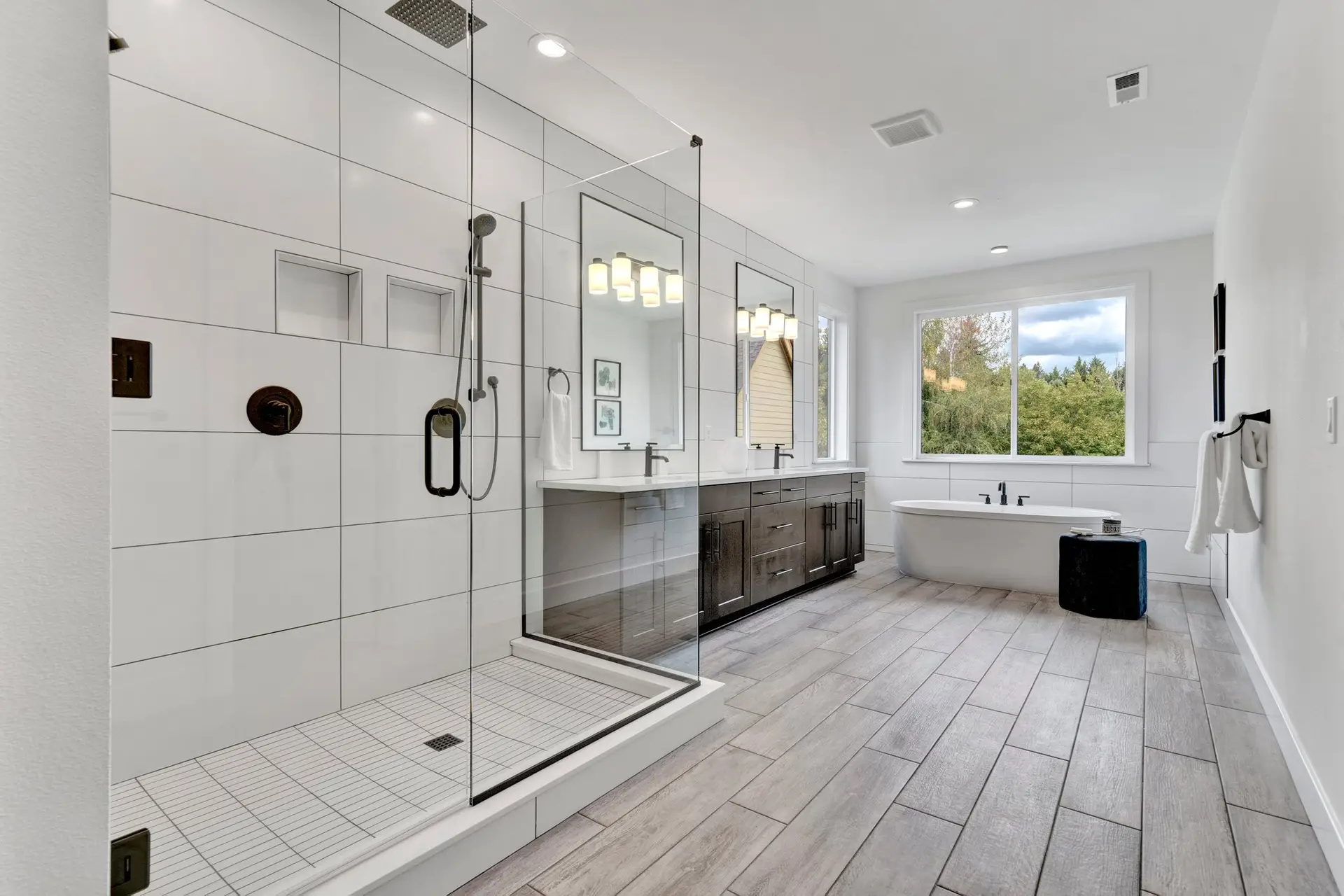
The bathroom is the smallest room in the house with the highest concentration of things that ruin floors: standing water, daily humidity swings, cleaning chemicals, and bare feet that notice every cold tile and slippery spot. It’s also a room where the floor, the shower, and the vanity top are all seen in a single glance, so the surfaces have to work together — not just individually.
This guide covers the practical side first — which materials genuinely belong in a wet room, what slip ratings mean, and what has to happen beneath the tile in a shower — and then the design side: pairing floors and quartz vanity tops so the finished bathroom looks planned. It’s written for bathroom remodels of any size, from a powder room refresh to a full primary suite.
What a Bathroom Floor Has to Handle
-
-
- Standing water — from the shower exit, the tub, kids, and the occasional overflow
- Daily humidity cycling that stresses anything with a wood or fiberboard core
- Slip hazard when wet, which matters more here than anywhere else in the house
- Harsh cleaners: bleach, acidic descalers, and abrasive scrubs
- Cold — bathrooms are often on exterior walls or over unheated spaces, and bare feet notice
- Small, cut-heavy layouts around toilets, vanities, and tubs that punish products which don’t cut cleanly
-
Porcelain Tile: The Bathroom Standard
Porcelain is the default bathroom floor for good reason. With a water absorption rate under 0.5%, it is unaffected by moisture, unaffected by every bathroom cleaner, and effectively permanent. It’s also the only flooring category that extends seamlessly onto the shower floor and walls, which lets you design the room as one continuous surface.
Specification for bathrooms:
-
-
- Slip resistance: look for a dynamic coefficient of friction (DCOF) of 0.42 or higher for the main floor — that’s the ANSI A137.1 threshold for wet areas. Matte, textured, and honed finishes get there; polished porcelain generally does not.
- Format: 12×24 and larger has become standard for bathroom floors and makes small rooms feel bigger. For the shower floor, 2×2 mosaics or small-format tile are still preferred — more grout lines mean more grip and the small pieces conform to the slope toward the drain.
- Rectified edges: precision-cut tile allows 1/16″ grout joints, reducing the grout that has to be cleaned and sealed.
- Grout: epoxy or urethane grout resists mildew and staining far better than cement grout. It costs more and is harder to install, but in a bathroom it’s the upgrade that pays for itself in maintenance.
- Wood-look porcelain: a strong choice for homeowners who want warmth in a bathroom without the moisture risk of real wood. Plank formats run beautifully in long, narrow bathrooms.
-
Luxury Vinyl Tile and Plank: The Practical Alternative
Rigid core LVT and LVP have become the leading alternative to tile in bathrooms — particularly in secondary baths, powder rooms, and remodels where budget or height constraints rule out tile. The plank or tile itself is 100% waterproof, it’s warmer and softer than porcelain, it installs quickly without curing time, and stone-look and marble-look formats create a high-end appearance at a fraction of the cost.
The honest limitations: LVT cannot go in the shower or wet-wall zone, and “waterproof” describes the product, not the installation. Water that reaches the seams and sits on a wood subfloor can still cause damage. For a bathroom, that means:
-
-
- Seal the perimeter with a flexible, mildew-resistant silicone at the tub, shower base, toilet flange, and vanity
- Choose an SPC rigid core, which is the most dimensionally stable through humidity swings
- Confirm the manufacturer’s warranty specifically covers full bathrooms — most quality rigid core products do, but verify
- Use a textured, matte surface for slip resistance; glossy LVT is slick when wet
-
LVT is also the best option for a bathroom over a slab or an older subfloor that isn’t flat enough for tile, since it tolerates minor imperfections that would crack a large-format porcelain.
Natural Stone: Beautiful, with Conditions
Marble, travertine, limestone, and slate are spa-bathroom classics, and there’s no synthetic that fully captures their depth. But every natural stone is porous and needs sealing on installation and periodically thereafter — and in a bathroom, sealing schedules get missed. Marble and limestone etch from acidic cleaners and even some toiletries. Polished stone is dangerously slippery when wet.
If you want stone, honed or tumbled finishes are safer underfoot, slate and dense granites are the most forgiving of moisture, and a pH-neutral cleaner should be the only thing that ever touches the floor. For most homeowners, marble-look porcelain delivers the aesthetic with none of the upkeep, which is why it now outsells real marble in bathrooms many times over.
What to Keep Out of the Bathroom
-
-
- Laminate — the fiberboard core swells with humidity alone, no spill required
- Solid hardwood — cupping and finish failure are a matter of when, not if
- Carpet — moisture, mildew, and hygiene make this a genuinely poor choice, though it still appears in older homes
- Polished tile or stone as the main floor — the slip risk isn’t worth the shine
- Standard flexible sheet vinyl — fine for budget rentals, but it dents, tears, and looks dated quickly compared to rigid core LVT at a similar price
-
Shower Waterproofing: What Happens Beneath the Tile Matters Most
Tile is not waterproof. Grout and the tile assembly are water-resistant at best. What keeps water out of the walls and subfloor is the waterproofing system beneath the tile, and this is where bathroom remodels succeed or fail years later. A properly built shower includes:
-
-
- A sloped, waterproofed shower pan — either a traditional mortar bed with a liner or, increasingly, a bonded sheet-membrane or liquid-applied system that waterproofs the entire pan and walls as one assembly
- Waterproofing on the walls, not just the floor — moisture-resistant drywall or cement board alone is not a waterproofing layer
- Properly integrated drain and curb — the drain flange and curb are where most leaks originate
- Sealed niches and benches, which are the most frequently botched details in DIY and low-bid showers
-
Ask any bathroom contractor to name the waterproofing system they use and how the drain integrates with it. A clear answer is the single best predictor of a shower that stays dry behind the walls.
Radiant Heat: The Bathroom Upgrade People Wish They'd Done Sooner
Electric radiant heat mats beneath tile or approved LVT solve the bathroom’s biggest comfort complaint — cold floors — for a modest cost on a small room. The mats add minimal height, run on a programmable thermostat so the floor is warm when you wake up and off when you leave, and cost very little to operate in a bathroom-sized space. Because the floor is being replaced anyway, the marginal cost is almost entirely the mat and thermostat. Few upgrades earn as much daily appreciation per dollar.
Quartz Vanity Tops: Pairing the Counter with the Floor
Quartz has become the leading vanity top material for the same reasons it dominates kitchens: non-porous, stain-resistant, unaffected by cosmetics and cleaners, and available in every look from solid white to full marble veining. Bathroom-specific notes:
-
-
- 2cm quartz is common for vanity tops (versus 3cm in kitchens) since spans are shorter and weight matters on vanity cabinets — though 3cm reads more substantial in a primary bath
- Integrated or undermount sinks keep the surface easy to wipe; vessel sinks make a statement but add a cleaning ledge
- A 4″ quartz backsplash is practical; a full-height quartz or tile backsplash to the mirror is the more current look
-
Pairing principles that consistently work:
-
-
- Let the floor or the vanity top carry the pattern — not both. A dramatic marble-look quartz wants a calm floor; a patterned floor wants a quiet counter.
- Match undertones: warm-white quartz with warm-toned wood-look or beige tile; cool white with grey tones. Crossing warm and cool is the most common bathroom mistake.
- Repeat one element: pick a grey from the quartz veining and use it in the floor, or echo the floor’s tone in the vanity cabinet.
- In small bathrooms, keep floor and vanity top light and low-contrast to make the room feel larger; save contrast for the vanity cabinet or hardware.
-
Bring a floor sample to the vanity-top selection, or vice versa. Bathroom lighting is often the least flattering in the house, so view both under similar light before committing.
Room-by-Room Bathroom Recommendations
-
-
- Primary bath: large-format matte porcelain with radiant heat, small-format mosaic in the shower, 3cm quartz vanity top with undermount sinks
- Family/hall bath: textured porcelain or SPC LVT, epoxy grout, durable 2cm quartz top that handles toothpaste and cosmetics
- Powder room: the place for bold choices — patterned tile, dramatic quartz, or a statement floor, since the room is small and easy to change later
- Basement bath: porcelain over an uncoupling membrane, or SPC LVT; radiant heat is especially worthwhile over a cold slab
-
Common Questions
Is LVT really okay in a full bathroom with a shower?
For the floor outside the shower, yes — with sealed perimeters and a rigid core product warranted for bathrooms. Inside the shower or on wet walls, no. Tile is the only material that belongs in the shower itself.
Do I need to seal porcelain tile?
Porcelain itself, no. Cement grout, yes — annually in a bathroom. Epoxy or urethane grout eliminates the sealing schedule, which is why we recommend it in wet rooms.
What’s the best bathroom floor for an older home with an uneven subfloor?
SPC rigid core LVT tolerates minor imperfections that would crack tile. If you want tile, budget for subfloor leveling and an uncoupling membrane, and lean toward smaller formats that follow the floor rather than 24×48 slabs that demand near-perfect flatness.
Plan Your Bathroom Surfaces at Trinity Flooring
Bathrooms are where material choices, waterproofing, and design have to work together — and where pairing the floor with the vanity top makes the difference between a remodel that looks finished and one that looks assembled. Our Portland showroom has bathroom-rated tile, LVT, and quartz vanity tops side by side, and our team can help you coordinate the whole package.
Visit us to compare samples in person, or contact us to schedule a free in-home measurement and estimate.