

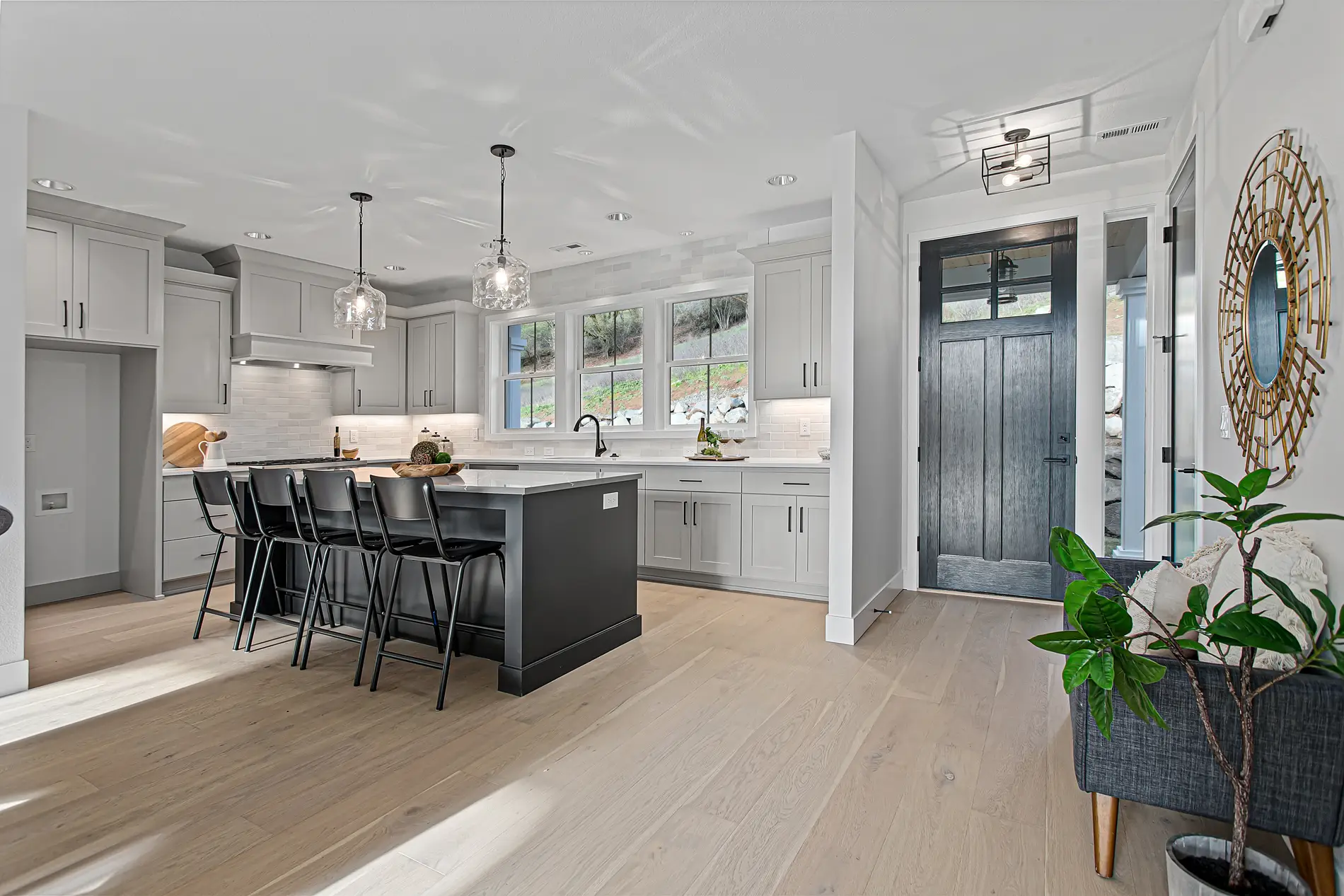
Hardwood flooring has endured as a top choice for homeowners for centuries — and with good reason. It adds warmth, character, and genuine long-term value to a home. Unlike any synthetic flooring product, real hardwood can be sanded and refinished multiple times over its lifetime, effectively giving you a brand-new floor without replacement cost. Done right, a hardwood floor can outlast the home itself.
But hardwood is also one of the most nuanced flooring categories to shop. Solid vs. engineered, species selection, grade, finish, and installation method all significantly affect performance and cost. This guide walks you through each decision point so you can buy with confidence.
Solid Hardwood vs. Engineered Hardwood
This is the foundational question in any hardwood purchase. Both products contain real wood — the difference is in how they’re constructed.
Solid Hardwood
Solid hardwood is milled from a single piece of wood, typically 3/4 inch thick. It can be sanded and refinished four to seven times over its lifetime, making it a truly generational investment. Solid hardwood must be nailed or stapled to a wood subfloor and is not recommended for basements or areas with moisture exposure. It also needs to acclimate to your home’s humidity levels before installation (typically 3–5 days).
Engineered Hardwood
Engineered hardwood consists of a real wood veneer bonded to multiple layers of plywood or high-density fiberboard. This cross-ply construction makes it significantly more dimensionally stable than solid wood — it expands and contracts less with changes in humidity, making it suitable for basements, over radiant heat systems, and even some above-ground bathroom applications. It can typically be refinished one to three times depending on veneer thickness. Installation options include float, glue-down, or nail-down.
For most Pacific Northwest homes where humidity swings are common, engineered hardwood often performs more predictably than solid wood. It also opens up installation options that solid wood can’t accommodate.
Choosing a Wood Species: Beauty and Hardness
Wood species determines color, grain pattern, and — critically — hardness. Hardness is measured by the Janka scale, which tests the force required to embed a steel ball into the wood. Higher Janka ratings mean better resistance to dents and scratches.
- Red Oak (Janka: 1,290): The most popular hardwood species in North America. Warm reddish-brown tones with prominent grain. Excellent value and widely available.
- White Oak (Janka: 1,360): Slightly harder than red oak with a cooler, more neutral tone. Currently the most in-demand species for contemporary and transitional designs.
- Hickory (Janka: 1,820): One of the hardest domestic species. Bold, dramatic grain with natural color variation. Excellent for rustic or farmhouse aesthetics and high-traffic areas.
- Hard Maple (Janka: 1,450): Light, creamy color with subtle grain. Popular for modern and Scandinavian-influenced designs. Excellent durability.
- American Walnut (Janka: 1,010): Richly colored from chocolate brown to tan with a straight, elegant grain. Among the most visually luxurious options, though softer than oak.
- Brazilian Cherry / Jatoba (Janka: 2,350): An exotic species with extraordinary hardness and a distinctive red-orange hue. Impressive durability but a bold aesthetic statement.
Understanding Hardwood Grades
Hardwood is graded by the character of the wood’s surface, not by its structural quality. Higher grades contain fewer natural features; lower grades have more character marks.
- Clear/Select: Minimal knots, consistent color, clean appearance. The most formal and uniform look. Premium pricing.
- 1 Common: Some color variation, minor knots, and natural character. A classic, popular choice that balances consistency with warmth.
- 2 Common: More pronounced knots, mineral streaks, and color variation. Creates a rich, rustic aesthetic. More affordable and increasingly popular in contemporary design.
There’s no wrong grade — it’s entirely a matter of aesthetic preference. Many designers today prefer No. 2 Common for its natural, lived-in character.
Prefinished vs. Site-Finished Hardwood
- Prefinished: Stained and finished at the factory under controlled conditions with aluminum oxide wear coatings. Ready to walk on immediately after installation. Faster, cleaner, and the finish is often more durable than site-applied alternatives. Minor beveled edges between planks.
- Site-Finished: Installed raw and sanded, stained, and finished in place. Produces a completely seamless, flat surface with no micro-bevels. Allows for fully custom stain colors. Requires the home to be vacated during the finishing process (typically 3–5 days) due to odors and drying time.
Prefinished is the right choice for most residential projects due to speed, convenience, and durability. Site-finishing is worth considering for full custom projects or when a perfectly level surface is a priority.
Plank Width: Narrow Strip or Wide Plank?
Traditional hardwood flooring runs from 2 1/4 to 3 1/4 inches wide. Wide plank flooring (5 inches and above) has surged in popularity, offering a more open, contemporary look that showcases the wood grain beautifully. Wide planks require better-quality, more stable wood or engineered construction to prevent cupping and gapping. For most modern installations, 5″ to 7″ widths hit the sweet spot between aesthetics and stability.
Hardwood and Moisture: What You Need to Know
Wood and moisture are natural adversaries. Before installing any hardwood, conduct a moisture test on your subfloor. The subfloor moisture content should be within 2–4% of the hardwood’s moisture content at installation. In Oregon’s wet climate, this step is non-negotiable. Always run your home’s HVAC system before hardwood installation to bring the environment to normal living conditions. Maintain indoor humidity between 35–55% year-round to protect your investment.
Expert Hardwood Installation and Selection at Trinity Flooring
Selecting the right hardwood is only half the equation — proper installation is equally critical to long-term performance. Our installation teams follow manufacturer guidelines, conduct subfloor moisture testing, and properly acclimate every product before it goes down. We carry an extensive selection of both solid and engineered hardwood in a range of species, grades, and finishes.
Visit our Portland showroom to explore the full collection, or call to schedule an in-home consultation and free estimate.